Here is a video showing how I've explained division with remainders (expressing the remainder as a fraction) to the kids. It's pretty tough, but they'll get it! One thing I forgot to note in the video is that the fraction does NOT need to be simplified. This is one extra complicated step that we just don't need to worry about at this point. Thanks and enjoy!
Wednesday, May 21, 2014
Division with Remainders - Expressing the Remainder as a fraction
Hello Families!
Here is a video showing how I've explained division with remainders (expressing the remainder as a fraction) to the kids. It's pretty tough, but they'll get it! One thing I forgot to note in the video is that the fraction does NOT need to be simplified. This is one extra complicated step that we just don't need to worry about at this point. Thanks and enjoy!
Here is a video showing how I've explained division with remainders (expressing the remainder as a fraction) to the kids. It's pretty tough, but they'll get it! One thing I forgot to note in the video is that the fraction does NOT need to be simplified. This is one extra complicated step that we just don't need to worry about at this point. Thanks and enjoy!

Tuesday, April 29, 2014
Gallons, Quarts, Pints, and Cups - oh my!
Hello Families!
Maybe I'm alone here, but gallons, quarts, pints and cups have always been tricky for me. How many pints in a gallon? How many cups in a quart? I have always had a hard time remembering these!! Your child will be bringing home a math page with gallon/quart/pint/cup conversions on it tomorrow (Wednesday) and I wanted to share a picture with you that I use to teach them (and remind myself!) about the conversions.
 This picture shows that in one gallon, there are 4 quarts. In each quart, there are 2 pints. In each pint, there are 2 cups! So, back to my original puzzling questions, how many pints in a gallon? 8! (you just count how many P's are inside the big G) How many cups in a quart? 4! Honestly, I imagine this picture any time I need to know this info!
I hope this helps! Happy homeworking!
Maybe I'm alone here, but gallons, quarts, pints and cups have always been tricky for me. How many pints in a gallon? How many cups in a quart? I have always had a hard time remembering these!! Your child will be bringing home a math page with gallon/quart/pint/cup conversions on it tomorrow (Wednesday) and I wanted to share a picture with you that I use to teach them (and remind myself!) about the conversions.
I hope this helps! Happy homeworking!
Monday, March 31, 2014
Equivalent Fractions
Hello!
Tonight's homework has some interesting language on it. Check the video below if you're having a hard time understanding what they're asking for. It's tricky!
Thanks for checking your child's homework every night!!
Tonight's homework has some interesting language on it. Check the video below if you're having a hard time understanding what they're asking for. It's tricky!
Wednesday, March 19, 2014
Fraction of a Set
Hi Everyone!
We have started our fractions unit! This is a pretty tough unit, so please make sure you're checking over your child's homework EVERY night! You play a huge role in their math success!
Here is a video to aid you in helping them with fraction of a set (tonight's homework)
Happy Homeworking!
-Mrs. McGaffey
We have started our fractions unit! This is a pretty tough unit, so please make sure you're checking over your child's homework EVERY night! You play a huge role in their math success!
Happy Homeworking!
-Mrs. McGaffey
Monday, March 3, 2014
March Monthly Math Challenge
Greetings!
The monthly math challenge for March has been released and it all centers around Pi Day (3/14). We don't use pi much in 3rd grade, but Mrs. Gaylord has constructed a number of fun activities for kids of all ages to start understanding pi!
See below for the challenge - there are 2 parts. Your child can do an activity then respond to the reflection, and/or memorize as many digits of pi as possible and recite them for a cool pencil!
Pi is: 3.14159265358979323846264338327950288419716939937510582097494459230781640628620899862803482534211706798214808651328230664709384460955058223172535940812...
The monthly math challenge for March has been released and it all centers around Pi Day (3/14). We don't use pi much in 3rd grade, but Mrs. Gaylord has constructed a number of fun activities for kids of all ages to start understanding pi!
See below for the challenge - there are 2 parts. Your child can do an activity then respond to the reflection, and/or memorize as many digits of pi as possible and recite them for a cool pencil!
March
Phantom Lake Monthly Math Challenge
Pi Day
Fun!
Introduction
Pi (π) is
the ratio of the circumference (the distance all the way around a circle) to
the diameter (the distance straight across a circle). Did you know it is always the same number? Pi
begins 3.1415, and no matter how many decimal places you travel, it never
ends! Because this number never ends and
never repeats as a predictable pattern it is called an irrational number.
March 14 is
Pi Day! (Because it’s 3/14; get it?) It just so happens that 3/14 was also
Albert Einstein’s birthday. In honor of this international celebration, you
have the opportunity to try out some Pi activities. Select the one that interests you the most
and turn in the Pi Day Reflection form by the end of the month.
For those of you interested in
participating in a Pi recitation contest, practice memorizing the digits. The
first 12 numbers are 3.1415926538. To see the first million digits, visit: http://www.piday.org/
Here is a great site to practice
learning the digits:
There are even pi trainer sites:
The contest will be held Thursday,
March 13th in Room#204 starting at 2:30.
You must get permission from your
teacher and a pass. You may come anytime between 2:30 and 3:00 to recite Pi and
win a Pi pencil. *Teachers, please send only 3-5 students at a time.
Thank you!
1. Pi Paper
Chain
Even the youngest mathematician can participate in the first
two activities!
Different colored paper strips are paired with numbers (e.g.,
blue for 2, red for 4). The strips are then linked in the order of π (3.1415…).
The chain can be as long or as short as time and interest allows.
1.
Pony Bead Bracelet
This activity is similar to the paper chain except students
can use plastic pony beads (really any bead or even snipped colored straws) and
pipe cleaners or yarn. Different colored
beads are paired with numbers just like in the paper chain activity.
2.
Cutting Pi
This activity helps students visualize what 3.14 actually
means. Find a cylindrical object (cans jars, and glasses or bowls), wrap a
string around the outside of the cylinder and cut the strong so it is exactly
the cylinder’s circumference. Take the circumference string and stretch it
across the diameter of the cylinder. How many diameters would you be able to
cut from the string? The answer should be three and a little piece left over,
or 3.14. (Activity from Disney
Family Fun, check out the site: http://spoonful.com/family-fun/who-doesnt-love-pi-day)
To find π with paper pencil, divide the circumference of the
circle (all the way around) by the diameter (the length from one side of the
circle to the other): C÷d=π
3.
Pi Ku
Write a p-ku, a three-line poem with three syllables in the
first line, one in the second, and four in the third.
4.
Pi Ku Plus
Write a poem in which each line corresponds to the number of
syllables in π-so you would have three syllables in the first line, one in the
second, four in the third, one in the fourth and so on. How many lines of Pi
can you write?
5.
Am I in Pi?
Enter your birthday to
where it appears in pi
6.
Your Life In Pi Years
7.
Beautiful Hyptrochoids
You can use a spirograph to make circles within circles. This
web site lets you try it with technology:
http://wordsmith.org/~anu/java/spirograph.html
I need to give credit to the
following web sites for information, ideas, and text:
Name_______________________________Teacher________________
π Day Reflections
What
activity did you complete?
_____________________________________________________________________________________________________________________
What did you
learn from the activity?
_____________________________________________________________________________________________________________________
What
questions do you have about pi?
_____________________________________________________________________________________________________________________
Tuesday, February 11, 2014
Elapsed Time
Hello!
We are in the middle of a quick unit on time, and the toughest concept so far has been elapsed time. We are trying to figure out how much time has passed, or when a certain event will end if it starts at a certain time and lasts a certain number of minutes. It's hard, because kids want to use subtraction, but that doesn't always work! (Think, if you try to do 3:10 minus 40 minutes, using the standard subtraction algorithm, it just won't work!) Here is a video for how we discuss it in class. Hope it helps with the homework!!
(PS. my class phone rings 3 times in this video...aaannnoying!!! Sorry about that! )
We are in the middle of a quick unit on time, and the toughest concept so far has been elapsed time. We are trying to figure out how much time has passed, or when a certain event will end if it starts at a certain time and lasts a certain number of minutes. It's hard, because kids want to use subtraction, but that doesn't always work! (Think, if you try to do 3:10 minus 40 minutes, using the standard subtraction algorithm, it just won't work!) Here is a video for how we discuss it in class. Hope it helps with the homework!!
Monday, January 13, 2014
Comparison Problems (Multiplication and Division)
Hello Families!
Tuesday, we begin comparison problems with multiplication and division! The problems are pretty tricky, so watch the video below for some pointers on how to help your child at home! Enjoy :)
Tuesday, we begin comparison problems with multiplication and division! The problems are pretty tricky, so watch the video below for some pointers on how to help your child at home! Enjoy :)
Thursday, December 12, 2013
Perimeter and Area
Hello All!
Our homework calls for some tough work related to area and perimeter. Students must find ALL rectangles with a certain perimeter and ALL rectangles with a certain area. Here is a video to show how I taught it in class, and how to use an organized list to make sure they record all possible rectangles! Enjoy~
Tuesday, December 3, 2013
Geometry Vocabulary
Hello!! We recently started a small unit on geometry! It's very heavy in vocabulary, so I thought I would share a picture of our vocabulary wall with you. That way, you can help out with your child's homework, or give them a little pop quiz in the car on the way to karate :)

I hope this helps you support your child in their math learning at home!!

I hope this helps you support your child in their math learning at home!!
Friday, November 15, 2013
Types of Multiplication and Division Story Problems (and flashcard fun!)
Hello everyone!
Yesterday's homework featured different types of multiplication and division story problems, and looking back, I wish I would have posted this sooner! Either way, here is a breakdown and examples of each type of story problem:
Array Multiplication
Both factors are known and items are arranged in rows and columns.
Example:
There are 3 rows of flowers. Each row has 4 flowers in it. How many flowers are there altogether? 3 x 4 = 12 flowers
Array Division
The total product is known (dividend) and one other factor (either number of rows or columns) is known.
Example:
There are 12 flowers in a garden. They are arranged in three rows. How many flowers are in each row? 12 ÷ 3 = 4 in each row.
Repeated Groups Multiplication
The two factors are known. One is the number of groups and the other is the size of each group.
Example:
There are 5 dogs. Each dog has 4 legs. How many legs are there altogether? 5 x 4 = 20 legs.
Repeated Groups Division (group size unknown)
The total product is known and the number of groups is known.
Example:
I see 20 dog legs. I know there are 5 dogs and each dog has the same number of legs. How many legs does each dog have? 20 ÷ 5 = 4 legs on each dog.
Repeated Groups Division (number of groups unknown)
The total product is known and the number of groups is known.
Example:
I see 20 dog legs. I know each dog has 4 legs. How many dogs are there? 20 ÷ 4 = 5 dogs
I hope this helps as your child brings these types of problems home for homework! Speaking of bringing things home...your child will be bringing multiplication flash cards home today! Please keep these in a safe place - their study plan will often include practicing with their flash cards! We learned today to make 3 piles. A pile of "YES! I know this one right away" a pile of "Hmm..I had to think about it, but got it right eventually" and a pile of "I have no clue." When they go through all of their cards, they set aside the ones they knew right away and go through the other two piles again. Please help them with this as much as possible!!
Thanks for continuing to support your child with mutliplication and division :)
Yesterday's homework featured different types of multiplication and division story problems, and looking back, I wish I would have posted this sooner! Either way, here is a breakdown and examples of each type of story problem:
Array Multiplication
Both factors are known and items are arranged in rows and columns.
Example:
There are 3 rows of flowers. Each row has 4 flowers in it. How many flowers are there altogether? 3 x 4 = 12 flowers
Array Division
The total product is known (dividend) and one other factor (either number of rows or columns) is known.
Example:
There are 12 flowers in a garden. They are arranged in three rows. How many flowers are in each row? 12 ÷ 3 = 4 in each row.
Repeated Groups Multiplication
The two factors are known. One is the number of groups and the other is the size of each group.
Example:
There are 5 dogs. Each dog has 4 legs. How many legs are there altogether? 5 x 4 = 20 legs.
Repeated Groups Division (group size unknown)
The total product is known and the number of groups is known.
Example:
I see 20 dog legs. I know there are 5 dogs and each dog has the same number of legs. How many legs does each dog have? 20 ÷ 5 = 4 legs on each dog.
Repeated Groups Division (number of groups unknown)
The total product is known and the number of groups is known.
Example:
I see 20 dog legs. I know each dog has 4 legs. How many dogs are there? 20 ÷ 4 = 5 dogs
I hope this helps as your child brings these types of problems home for homework! Speaking of bringing things home...your child will be bringing multiplication flash cards home today! Please keep these in a safe place - their study plan will often include practicing with their flash cards! We learned today to make 3 piles. A pile of "YES! I know this one right away" a pile of "Hmm..I had to think about it, but got it right eventually" and a pile of "I have no clue." When they go through all of their cards, they set aside the ones they knew right away and go through the other two piles again. Please help them with this as much as possible!!
Thanks for continuing to support your child with mutliplication and division :)
Tuesday, November 5, 2013
The 9's Trick
Well, it had to happen sooner or later. It's my first post featuring ME in a video. Scary. Anyway, this is a quick illustration of the trick we learned for multiplying by 9! Enjoy!
Monday, November 4, 2013
November Monthly Math Challenge
Hello all!
This month's math challenge is here! It will be coming home in your child's folder today, but if you lose it, here it is! Please be sure to use the REC form to answer the questions!


Happy Challenging!
This month's math challenge is here! It will be coming home in your child's folder today, but if you lose it, here it is! Please be sure to use the REC form to answer the questions!


Happy Challenging!
Thursday, October 24, 2013
Multiplication and Division Homework!
Hello Families!
We started multiplication today! Hooray!! There are a few changes to homework for this unit. You'll be getting a family letter today with some of this information, but just to clarify, here's what you can expect! Heads up - every night your child needs a homework helper. This can be an adult, a sibling, or a friend. The homework helper will need to sign their homework every night!
Every night, your child will bring home TWO homework pages. The first page looks like this (front and back). On the front, your child should use the equations to practice their times tables by saying them all out loud. Then, have the homework helper quiz them on it! On the back, there are math facts with the answers at the bottom. They should cover the answers when they are completing it, then check their answers when they're done!


The other page will have a homework and remembering side like always. The new part here, is the study plan. In class, we'll write our study plan (Practice my fives 6 times etc.) and the homework helper must sign this page to prove that they actually carried out their study plan.

We started multiplication today! Hooray!! There are a few changes to homework for this unit. You'll be getting a family letter today with some of this information, but just to clarify, here's what you can expect! Heads up - every night your child needs a homework helper. This can be an adult, a sibling, or a friend. The homework helper will need to sign their homework every night!
Every night, your child will bring home TWO homework pages. The first page looks like this (front and back). On the front, your child should use the equations to practice their times tables by saying them all out loud. Then, have the homework helper quiz them on it! On the back, there are math facts with the answers at the bottom. They should cover the answers when they are completing it, then check their answers when they're done!

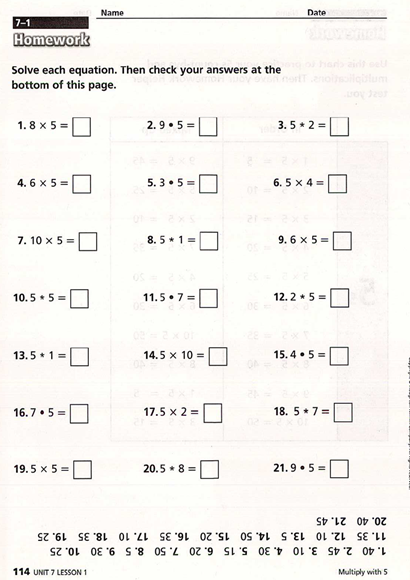
The other page will have a homework and remembering side like always. The new part here, is the study plan. In class, we'll write our study plan (Practice my fives 6 times etc.) and the homework helper must sign this page to prove that they actually carried out their study plan.

As you can see, there is a lot of parent involvement in this unit. Please carve out some time to help your child with their study plan. The kids who show the most success in this unit, practice the most at home! Memorizing their facts is key in this unit!
Thanks for being involved in your child's education!!
-Mrs. McGaffey
Thursday, October 10, 2013
Comparison Bars
Hello! We just began solving comparison story problems today, and I wanted to share a tool with you that we use to organize our thinking: COMPARISON BARS!!
While there is no homework over the long weekend, the homework next week will require kids to use comparison bars to solve their homework problems. Take a peek at the video to help you understand what comparison bars are and how they are used. Thanks!!
-Mrs. McGaffey
While there is no homework over the long weekend, the homework next week will require kids to use comparison bars to solve their homework problems. Take a peek at the video to help you understand what comparison bars are and how they are used. Thanks!!
-Mrs. McGaffey
Monday, October 7, 2013
Types of Story Problems
Hello Families!
We began Unit 3: Addition and Subtraction Story Problems today. I gave students a pre-test and will place them in math groups accordingly. These groups are flexible and as I see quick quizzes and in-class work, I will certainly adjust them. I wanted to give you a little heads up on some lingo that will be used in the homework.
(+)Change Plus Problem: A problem that begins with a given quantity that is then changed by adding more to it.
Example: Al has 4 toy cars. His mom bought him 5 more. How many does he have now? *note, he is adding more to his original quantity
(-)Change Minus Problem: A problem that begins with a given quantity that is then changed by taking some away.
Example: Joy had 12 apples. She ate 4. How many does she have now? *note, 4 are being taken away - they are done, gone, outta here.
(+)Put Together Problem: A problem that involves putting together (joining, combining) different groups of items to form a total.
Example: Anna has 3 oranges. Joel has 4 oranges. How many do they have altogether? *note, there were two separate quantities that are being combinedinto one group - we aren't actually changing the amount of oranges that are present, just combining
(-)Take Apart Problem: A problem that involves separating a group of objects.
Example: There were 12 horses in the field. Then, 4 went in the barn. How many are left in the field?*note, the horses that are being subtracted aren't actually going away, just going somewhere separate.
When tackling story problems in this unit, encourage your child to draw a math mountain! That way, he or she can see what we know, and what we need to figure out.
Happy homeworking!!
We began Unit 3: Addition and Subtraction Story Problems today. I gave students a pre-test and will place them in math groups accordingly. These groups are flexible and as I see quick quizzes and in-class work, I will certainly adjust them. I wanted to give you a little heads up on some lingo that will be used in the homework.
(+)Change Plus Problem: A problem that begins with a given quantity that is then changed by adding more to it.
Example: Al has 4 toy cars. His mom bought him 5 more. How many does he have now? *note, he is adding more to his original quantity
(-)Change Minus Problem: A problem that begins with a given quantity that is then changed by taking some away.
Example: Joy had 12 apples. She ate 4. How many does she have now? *note, 4 are being taken away - they are done, gone, outta here.
(+)Put Together Problem: A problem that involves putting together (joining, combining) different groups of items to form a total.
Example: Anna has 3 oranges. Joel has 4 oranges. How many do they have altogether? *note, there were two separate quantities that are being combinedinto one group - we aren't actually changing the amount of oranges that are present, just combining
(-)Take Apart Problem: A problem that involves separating a group of objects.
Example: There were 12 horses in the field. Then, 4 went in the barn. How many are left in the field?*note, the horses that are being subtracted aren't actually going away, just going somewhere separate.
When tackling story problems in this unit, encourage your child to draw a math mountain! That way, he or she can see what we know, and what we need to figure out.
Happy homeworking!!
Thursday, October 3, 2013
Double Checking with Opposite Operations
Hello Families!
We just took the Unit 1 assessment today, and I am SO proud of their work! You can expect a paper coming home with them tomorrow giving their score on the assessment and whether they exceeded, met, or did not meet standards for the unit. I send these home after every unit to keep you in the loop!
One thing I noticed that we need to work on, is double checking! It's natural for third graders to want to just be done with their work, but they need to be double checking! Since our next unit involves addition and subtraction story problems, I thought I would share a quick video showing how we learned to use the opposite operation (+ or -) to double check our answer. Enjoy!!
Ooh - one last thing! The new monthly math challenge is here! It's not on the PTA website quite yet, but I have copies! Please encourage your child to grab a copy and give a few problems a try!
Thanks!
-Mrs. McGaffey
We just took the Unit 1 assessment today, and I am SO proud of their work! You can expect a paper coming home with them tomorrow giving their score on the assessment and whether they exceeded, met, or did not meet standards for the unit. I send these home after every unit to keep you in the loop!
One thing I noticed that we need to work on, is double checking! It's natural for third graders to want to just be done with their work, but they need to be double checking! Since our next unit involves addition and subtraction story problems, I thought I would share a quick video showing how we learned to use the opposite operation (+ or -) to double check our answer. Enjoy!!
Ooh - one last thing! The new monthly math challenge is here! It's not on the PTA website quite yet, but I have copies! Please encourage your child to grab a copy and give a few problems a try!
Thanks!
-Mrs. McGaffey
Thursday, September 26, 2013
Relating Addition and Subtraction
Hello!
Today we had a tough lesson on solving story problems, then writing a related story problem using the same information. Check out the video below for some help if your child gets stuck on tonight's homework!
Happy homeworking!
-Mrs. McGaffey
Today we had a tough lesson on solving story problems, then writing a related story problem using the same information. Check out the video below for some help if your child gets stuck on tonight's homework!
-Mrs. McGaffey
Wednesday, September 25, 2013
Dreambox!
Dreambox is up and running! Dreambox is a website that students can login to from any computer. They will access their personal profile that directs them to math games and activities that build upon what they know, and push them to further their thinking!
To login, go to https://play.dreambox.com/login/x5s9/phantomle
Click on 3 - Mrs McGaffey
Enter your child's username and password (sent home Tuesday)
Enjoy!
To login, go to https://play.dreambox.com/login/x5s9/phantomle
Click on 3 - Mrs McGaffey
Enter your child's username and password (sent home Tuesday)
Enjoy!
Monday, September 23, 2013
Subtraction with regrouping
Hello Families!
Here is my first video on the blog! This will help you if your child gets stuck with subtraction regrouping. I showed the proof drawing and how that helps them connect what's going on in the equation, to what's actually happening with the hundreds, tens and ones. I forgot to add - Dr. Tens actually has a British accent as well. Mrs. Hundreds is a Jersey girl born and raised so her Jersey accent is pretty thick. This is just a fun little twist to make subtraction and addition a little more enjoyable for them :) Enjoy!!
Monday, September 16, 2013
Monthly Math Challenge
Did you know that Phantom Lake has a WONDERFUL math specialist? Well, we do! Her name is Laura Gaylord, and having worked with her in the past, I can tell you for sure, she is GREAT! She, along with the PTA, are putting together a monthly math challenge for kiddos who want to push their thinking in math. I highly suggest you give these a try with your child! Each kid that finishes even one problem will get a certificate.
One requirement is you use the R-E-C form. (Restate, explain, conclude). To find and print the REC form, click HERE
You can choose the problems that fit your child's needs, but challenge them to try intermediate problems if that's appropriate for them! Here are the challenge questions (also can be found on the PTA website as linked above)
I hope to see many of my kids turning these in as the month goes on! They can turn them in to me, or the office whenever they finish them, but no later than Sept. 30.

To collect the amount of nectar needed to make 2 pounds of honey, bees must travel a distance that is approximately the same as circling the Earth 4 times. If we continue to compare distance in this way, how many times would the bees have to travel around the Earth in order to collect enough nectar to make 4 pounds of honey?
Primary Problem B
Each honeybee has 5 eyes! Three honeybees are circling a flower. How many bee eyes are around the flower? Five honeybees are returning to the hive with nectar. How many bee eyes are returning to the hive? Now there are a total of 30 bee eyes in the flower garden. How many honeybees are in the garden?
Primary Problem C
When a bee is looking for nectar to make honey, it can travel about 1 mile in 4 minutes. How far can you travel in 4 minutes? Time yourself while running or walking. Use this data to determine how long it would take you to travel 1 mile?
Primary Problem D
A productive queen bee can lay 3,000 eggs in one day. How many eggs would that queen lay in 5 days? In 27 days? How many days would it take the queen bee to lay 19,000 eggs?
Intermediate Problem E
The distinctive buzzing noise that bees make comes from their wings beating. A bee wing beats about 11,400 times in a minute to create this buzz. How many times would its wings beat in 1 second? How many times would its wings beat in 5 minutes. In 1 hour?
Intermediate Problem F
To collect the amount of nectar needed to make 1 pound of honey, bees must tap 2 million flowers. How much honey can they produce if they tap only 300,000 flowers? How much honey can they produce if they tap 1,750,000 flowers? How many flowers do they need to tap to make 24.5 pounds of honey?
Intermediate Problem G
Bees require 1/3 ounce of honey to make the wax for a 2 1/4 –inch birthday candle. How much honey would be required to make the number of birthday candles needed for your tenth birthday?
Super Duper Challenge
If a bee’s wings beat 180 times in 1 second, how many times do they beat in 1 hour? In one day? The life span of a worker bee ranges from 28 to 35 days. On average, how many times does a worker bee flap its wings over its entire life span?
One requirement is you use the R-E-C form. (Restate, explain, conclude). To find and print the REC form, click HERE
You can choose the problems that fit your child's needs, but challenge them to try intermediate problems if that's appropriate for them! Here are the challenge questions (also can be found on the PTA website as linked above)
I hope to see many of my kids turning these in as the month goes on! They can turn them in to me, or the office whenever they finish them, but no later than Sept. 30.
Phantom Lake Math Challenge
September 2013
These problems are labeled in order of increasing difficulty. Choose the one that fits your math and grade ability and solve the problem. People at home can help you. You will need to submit your answer using the R-E-C form. Be certain to put the letter of your problem, your name and your teacher’s name on the form when you submit it. All solutions are due to Mrs. Gaylord by September 30th. Bring your completed R-E-C form to your teacher. Students who successfully complete the challenge with the correct answer and a logical explanation of their mathematical thinking will receive a certificate and their name listed on the Math Challenge poster at school. Happy problem solving!!
Primary Problem ATo collect the amount of nectar needed to make 2 pounds of honey, bees must travel a distance that is approximately the same as circling the Earth 4 times. If we continue to compare distance in this way, how many times would the bees have to travel around the Earth in order to collect enough nectar to make 4 pounds of honey?
Primary Problem B
Each honeybee has 5 eyes! Three honeybees are circling a flower. How many bee eyes are around the flower? Five honeybees are returning to the hive with nectar. How many bee eyes are returning to the hive? Now there are a total of 30 bee eyes in the flower garden. How many honeybees are in the garden?
Primary Problem C
When a bee is looking for nectar to make honey, it can travel about 1 mile in 4 minutes. How far can you travel in 4 minutes? Time yourself while running or walking. Use this data to determine how long it would take you to travel 1 mile?
Primary Problem D
A productive queen bee can lay 3,000 eggs in one day. How many eggs would that queen lay in 5 days? In 27 days? How many days would it take the queen bee to lay 19,000 eggs?
Intermediate Problem E
The distinctive buzzing noise that bees make comes from their wings beating. A bee wing beats about 11,400 times in a minute to create this buzz. How many times would its wings beat in 1 second? How many times would its wings beat in 5 minutes. In 1 hour?
Intermediate Problem F
To collect the amount of nectar needed to make 1 pound of honey, bees must tap 2 million flowers. How much honey can they produce if they tap only 300,000 flowers? How much honey can they produce if they tap 1,750,000 flowers? How many flowers do they need to tap to make 24.5 pounds of honey?
Intermediate Problem G
Bees require 1/3 ounce of honey to make the wax for a 2 1/4 –inch birthday candle. How much honey would be required to make the number of birthday candles needed for your tenth birthday?
Super Duper Challenge
If a bee’s wings beat 180 times in 1 second, how many times do they beat in 1 hour? In one day? The life span of a worker bee ranges from 28 to 35 days. On average, how many times does a worker bee flap its wings over its entire life span?
Subscribe to:
Posts (Atom)